Question 1 Every village in India is surveyed once in ten years during the Census and some of details are presented in the following format. Fill up the following based on information on Palampur. a. LOCATION: b. TOTAL AREA OF THE VILLAGE: c. LAND USE (in hectares):
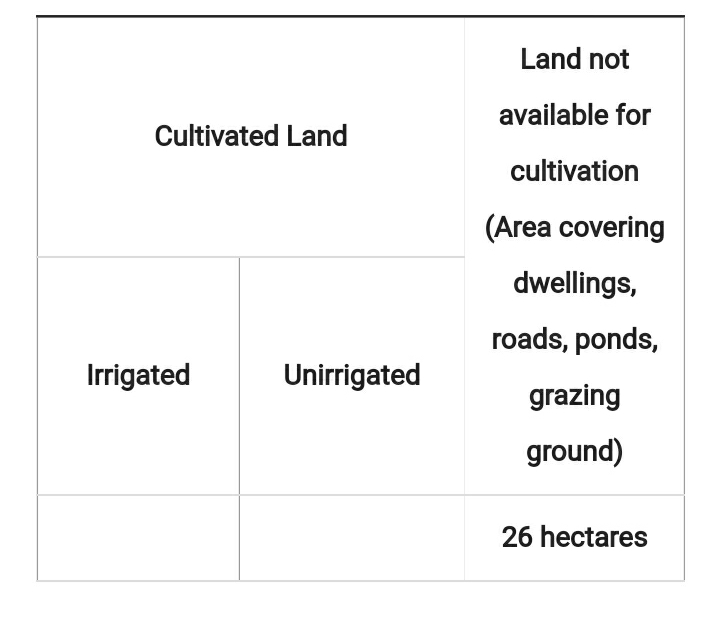
d. FACILITIES:
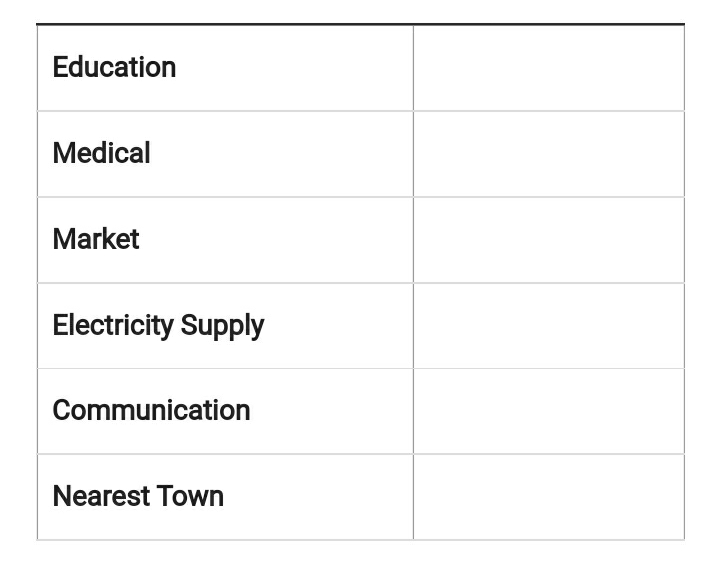
Answer:
a. LOCATION: Bulandshahr District, Western Uttar Pradesh b. TOTAL AREA OF THE VILLAGE: 226 hectares c. LAND USE (in hectares):
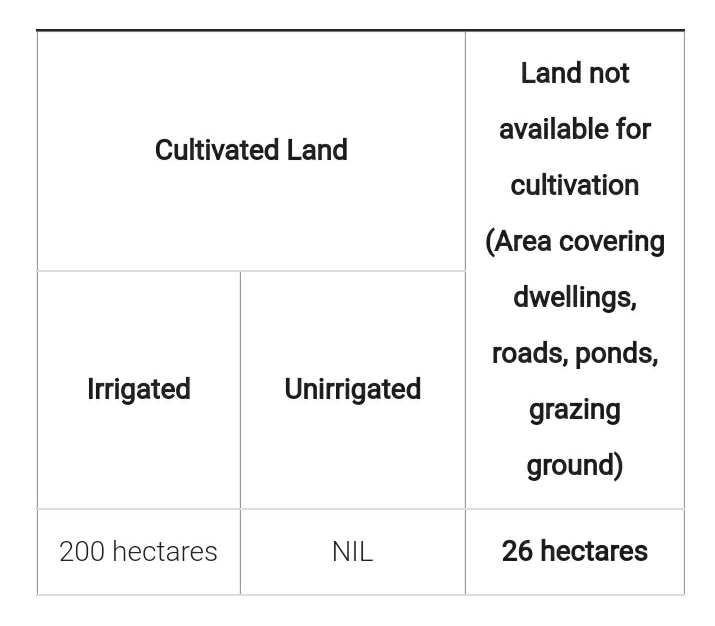
d. FACILITIES:
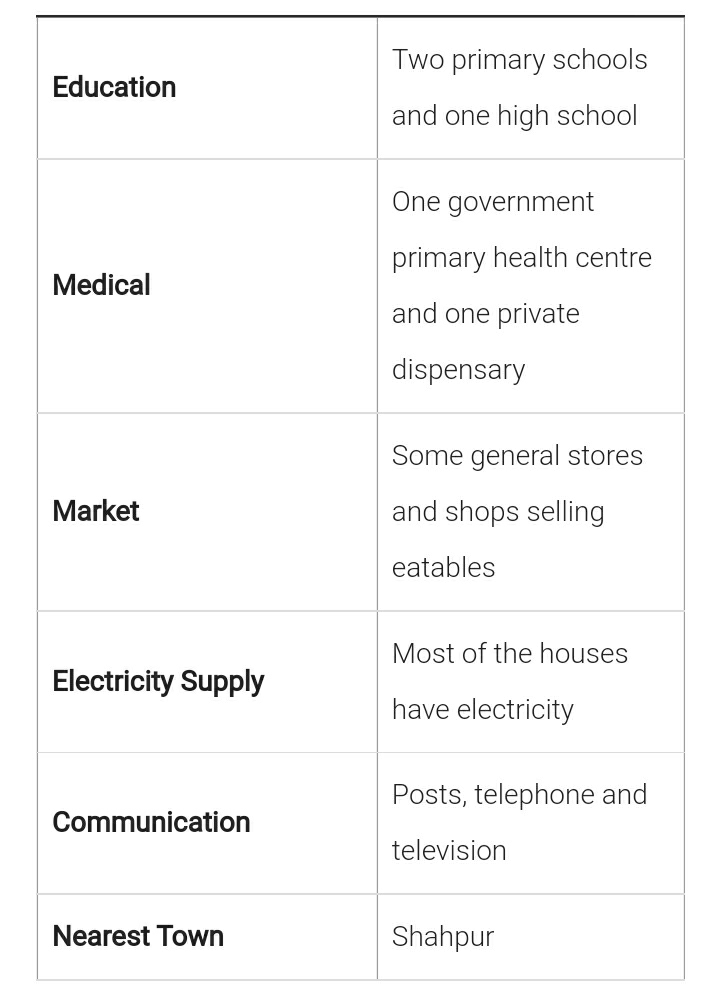
Question 2.
Modern farming methods require more inputs which are manufactured in industry. Do you agree?
Answer:
Yes, I agree that modern farming methods require more inputs than traditional farming. It requires inputs like chemical fertilizers, pesticides, pump sets, farm machinery, electricity, high yielding varieties of seeds, and water supply. Most of these outputs are manufactured in industries. Similarly, water supply is provided by canals and tanks.
Question 3.
How did the spread of electricity help farmers of Palampur?
Answer:
The spread of electricity helped the farmers in Palampur in the following ways:
- Most of the houses have electricity connections.
- It is used to run tubewells in the fields.
- It is used in various types of small businesses.
Question 4.
Is it important to increase the area under irrigation? Why?
Answer:
Irrigation facilities are available only to about 40% of the cultivated land area in the country. The rest of the land, i.e., 60% of the cultivated area, is still dependent on rainfall for irrigation. It means that the benefit of multiple cropping cannot be achieved by 60% of the farmers in the country. They produce less and so their income is also low. Thus, they live in poverty.
Therefore, if these farmers are to be brought out of poverty, farm productivity has to increase. This is only possible when they use modern farming methods and dependable irrigation facilities. Hence, it is important to increase the area under irrigation.
Question 5.
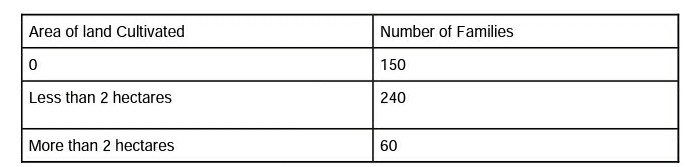
Construct a table on the distribution of land among the 450 families of Palampur.
Answer:
The distribution of land among the 450 families of Palampur is as given below:
Question 6.
Why are the wages for farm labourers in Palampur less than minimum wages?
Answer:
There are many landless farm labourers who are paid less than the minimum wages in Palampur. The Government declared wage for a farm labourer is Rs.300 per day but the competition for work among the farm labourers is very high, which is why people agree to work for lower wages.
Question 7.
In your region, talk to two labourers. Choose either farm labourers or labourers working at construction sites. What wages do they get? Are they paid in cash or kind? Do they get work regularly? Are they in debt?
Answer:
To be attempted by the students themselves.
Question 8.
What are the different ways of increasing production on the same piece of land? Use examples to explain.
Answer:
To grow more than one crop on a piece of land during the year is known as multiple cropping. It is the most common way of increasing production on a given piece of land. All farmers in Palampur grow at least two main crops; many are growing potato as the third crop in the past fifteen to twenty years.
Question 9.
Describe the work of a farmer with 1 hectare of land.
Answer:
A farmer who works on 1 hectare of land is called a small farmer. He carries out the following activities:
- Ploughs the field by bullocks or tractors
- Sows the seeds by simply sprinkling by hands
- Waters the field with the help of a Persian wheel
- Sprays the insecticides by manual pumps
- Cuts the crops by hand-operated tools
Question 10.
How do the medium and large farmers obtain capital for farming? How is it different from the small farmers?
Answer:
In contrast to the small farmers, the medium and large farmers have their own savings from farming. They are thus able to arrange for the capital needed.
Question 11.
On what terms did Savita get a loan from Tejpal Singh? Would Savita’s condition be different if she could get a loan from the bank at a low rate of interest?
Answer:
The terms of loan of Savita taken from Tejpal Singh are:
- She took loan of ₹ 3.000 at an interest rate of 24 percent.
- She would have to repay the loan in four months.
- She also has to work on Tejpal’s field as a farm labourer during the harvesting season at ₹ 35 per day.
The bank could have provided her loan at a low rate of interest. In addition, she would have devoted more time to her own field of 1 hectare, instead of working as a farm labourer for Tejpal Singh.
Question 12.
Talk to some old residents of your region and write a short report on the changes in irrigation and changes in production methods during the last 30 years.
Answer:
Students must do this question based on their own observation.
Question 13.
What are the non-farm production activities taking place in your region? Make a shortlist.
Answer:
The non-farm production activities taking place in our region are: 1. Dairy 2. Transportation 3. General Stores 4. Fishing 5. Mining
Question 14.
What can be done so that more non-farm production activities can be started in villages?
Answer:
The villagers must be made aware of the non-farm production activities and their benefits. They must also be taught the methods of doing such activities. The villagers who have the impression that they can earn only by farming, must be given proper guidance and help to do such activities.
 MRN Creator