Question 1. State whether the following statements are true or false. Justify your answers.
(i) Every irrational number is a real number. Solution: The collection of both rational and irrational numbers are known as real numbers. i.e., Real numbers = √2, √5, 0.102…
Every irrational number is a real number, however, every real numbers are not irrational numbers.
(ii) Every point on the number line is of the form √m where m is a natural number. Solution: The statement is false since as per the rule, a negative number cannot be expressed as square roots. E.g., √9 =3 is a natural number. But √2 = 1.414 is not a natural number.
(iii) Every real number is an irrational number. Solution: False
The statement is false, the real numbers include both irrational and rational numbers.
Question 2. Are the square roots of all positive integers irrational? If not, give an example of the square root of a number that is a rational number. Solution: No, the square roots of all positive integers are not irrational. For example,√4 = 2 is rational.
Question 3. Show how √5 can be represented on the number line. Solution:

Question 4. Classroom activity (Constructing the ‘square root spiral’) : Take a large sheet of paper and construct the ‘square root spiral’ in the following fashion. Start with a point O and draw a line segment OP1 of unit length. Draw a line segment P1P2 perpendicular to OP1 of unit length (see Fig. 1.9). Now draw a line segment P2P3 perpendicular to OP2. Then draw a line segment P3P4 perpendicular to OP3. Continuing in Fig. 1.9 :

Constructing this manner, you can get the line segment Pn-1Pn by square root spiral drawing a line segment of unit length perpendicular to OPn-1. In this manner, you will have created the points P2, P3,….,Pn,… ., and joined them to create a beautiful spiral depicting √2, √3, √4, …
Solution:
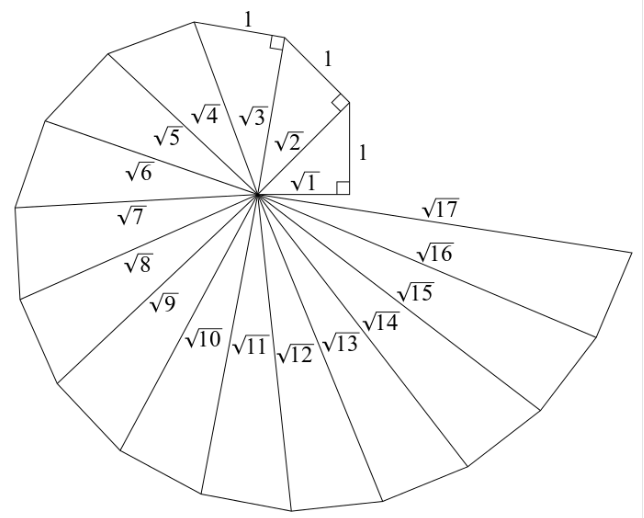
Step 1: Mark a point O on the paper. Here, O will be the center of the square root spiral.
Step 2: From O, draw a straight line, OA, of 1cm horizontally.
Step 3: From A, draw a perpendicular line, AB, of 1 cm.
Step 4: Join OB. Here, OB will be of √2
Step 5: Now, from B, draw a perpendicular line of 1 cm and mark the end point C.
Step 6: Join OC. Here, OC will be of √3
Step 7: Repeat the steps to draw √4, √5, √6….
 MRN Creator