NCERT Class 9 Beehive Page No. 38
Thinking about the Text
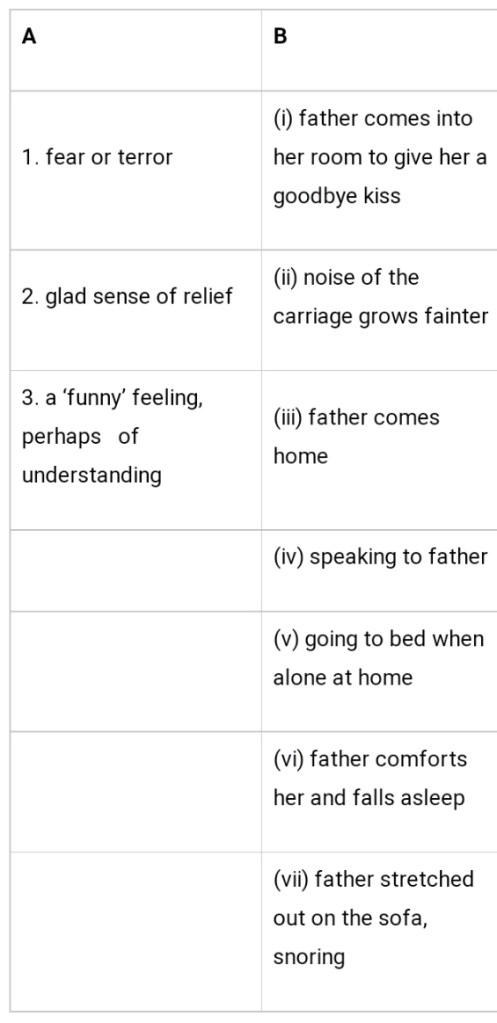
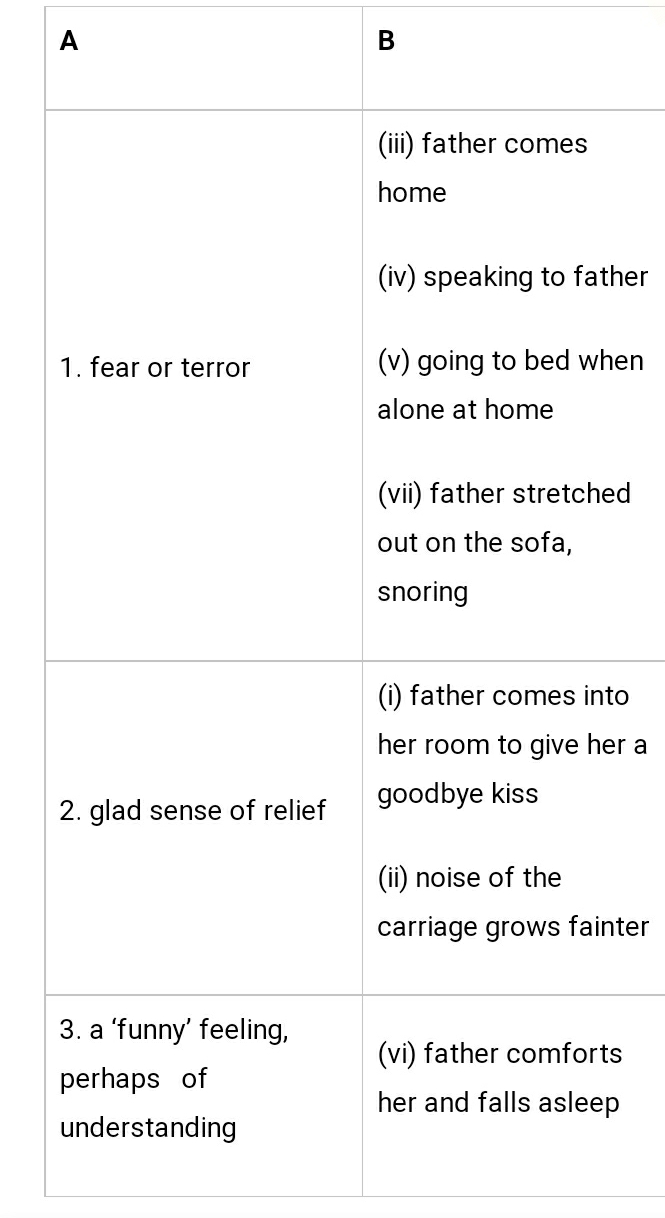
I. Given below are some emotions that Kezia felt. Match the emotions in Column A with the items in Column B.
Answer:
II. Answer the following questions in one or two sentences.
Question 1. Why was Kezia afraid of her father?
Answer:
Kezia was afraid of her father because he was very strict. He used to talk to her harshly. He was in a habit of finding out her mistakes.
Question 2. Who were the people in Kezia’s family?
Answer:
Kezia had her mother, father and grandmother in her family.
Question 3. What was Kezia’s father’s routine
(i) before going to his office?
(ii) after coming back from his office?
(iii) on Sundays?
Answer:
(i) Before going to his office, Kezia’s father went into her room to give her a casual kiss.
(ii) After coming back from his office, he would ask for newspaper and tea.
(iii) On Sundays, he would stretch out on the sofa with his handkerchief on his face, his feet on one of the best cushions, sleep and snore.
Question 4. In what ways did Kezia’s grandmother encourage her to get to know her father better?
Answer:
Kezia’s grandmother encouraged her to get to know her father better by sending her to the drawing room to talk to her parents on Sundays. She also suggested Kezia to make a gift of a pin-cushion on her father’s birthday.
III. Discuss these questions in class with your teacher and then write down your answers in two or three paragraphs each.
Question 1. Kezia’s efforts to please her father resulted in displeasing him very much. How did this happen?
Answer:
Kezia efforts to please her father resulted in displeasing him. On every Sunday, her grandmother sent her down to the drawing room to have a nice talk with her father and mother. But her father always got irritated with her. He used to call her ‘little brown owl’. One day her grandmother suggested her to make a gift of a pin-cushion on her father’s birthday. Kezia stuffed her pin-cushion with papers. But the sheets she had torn and filled in the cushion were her father’s speech for the Port Authority. He scolded her and punished her by hitting her palm with a ruler.
Question 2. Kezia decides that there are “different kinds of fathers”. What kind of father was Mr Macdonald, and how was he different from Kezia’s father?
Answer:
Kezia decides that there are “different kinds of fathers”.
Mr Macdonald was a loving father. He was very gentle and forgiving. He used to play and laugh with his children. He was friendly with them.
He was quite different from Kezia’s father. Her father was very strict and unfriendly.
Question 3. How does Kezia begin to see her father as a human being who needs her sympathy?
Answer:
One day, when her mother and grandmother were at the hospital, Kezia was left at home with Alice, their cook. At night, she had a nightmare. Shivering with fear, she called for her grandmother but saw her father near her bed. He took her in his arms and carefully tucked her on his bed. He then lay down beside her. Half asleep, she went close to him, snuggled her head under his arm and held onto his shirt tightly.
She saw her father go off to sleep before her. She understood that he had to work so hard every day which made him too tired to behave like Mr Macdonald. She told his father that he had a big heart.
Thinking about Language
I. Look at the following sentence.
There was a glad sense of relief when she heard the noise of the carriage growing fainter…
Here, glad means happy about something.
Glad, happy, pleased, delighted, thrilled and overjoyed are synonyms (words or expressions that have the same or nearly the same meaning.) However, they express happiness in certain ways.
Read the sentences below.
• She was glad when the meeting was over.
• The chief guest was pleased to announce the name of the winner.
Question 1. Use an appropriate word from the synonyms given above in the following sentences. Clues are given in brackets.
(i) She was __________ by the news of her brother’s wedding. (very pleased)
(ii) I was __________to be invited to the party. (extremely pleased and excited about)
(iii) She was __________ at the birth of her granddaughter. (extremely happy)
(iv) The coach was __________ with his performance. (satisfied about)
(v) She was very __________ with her results. (happy about something that has happened).
Answer:
- thrilled
- delighted
- overjoyed
- pleased
- happy.
Question 2. Study the use of the word big in the following sentence.
He was so big — his hands and his neck, especially his mouth…
Here, big means large in size.
Now, consult a dictionary and find out the meaning of big in the following sentences. The first one has been done for you.
- You are a big girl now. older
- Today you are going to take the biggest decision of your career …….
- Their project is full of big ideas …….
- Cricket is a big game in our country……..
- I am a big fan of Lata Mangeshkar……..
- You have to cook a bit more as my friend is a big eater ……..
- What a big heart you’ve got, Father dear ……..
Answer:
- most important
- great
- very popular
- great
- great
- very affectionate/large-hearted.
II. Verbs of Reporting
Study the following sentences.
• “What!” screamed Mother.
• “N-n-no”, she whispered.
• “Sit up,” he ordered.
The italicised words are verbs of reporting. We quote or report what someone has said or thought by using a reporting verb. Every reporting clause contains a reporting verb. For example:
• He promised to help in my project.
• “How are you doing?” Seema asked.
We use verbs of reporting to advise, order, report statements, thoughts, intentions, questions, requests, apologies, manner of speaking and so on.
Question 1. Underline the verbs of reporting in the following sentences.
- He says he will enjoy the ride.
- Father mentioned that he was going on a holiday.
- No one told us that the shop was closed.
- He answered that the price would go up.
- I wondered why he was screaming,
- Ben told her to wake him up.
- Ratan apologised for coming late to the party.
Answer:
- says
- mentioned
- told
- answered
- wondered
- told
- apologised
Question 2: Some verbs of reporting are given in the box. Choose the appropriate verbs and fill in the blanks in the following sentences.
were complaining, shouted, replied, remarked, ordered, suggested
- “I am not afraid” ………. , the woman.
- “Leave me alone,” my mother
- The children ……….. that the roads were crowded and noisy.
- “Perhaps he isn’t a bad sort of a chap after all” ……….., the master.
- “Let’s go and look at the school ground”……….., the sports teacher.
- The traffic police ……….. all the passers- by to keep off the road.
Answer:
- remarked
- shouted
- were complaining
- replied
- suggested
- ordered.
Speaking
Form pairs or groups and discuss the following questions.
Question 1. This story is not an Indian story. But do you think there are fathers, mothers and grandmothers like the ones portrayed in the story in our own country?
Answer:
There is no doubt that the Indian families too have such fathers, mothers and grandmothers. In this world of cut-throat competition everyone aspires for success. So, the parents (father and mother) get employed to provide the children with all the worldly comforts. But they fail to comprehend the psychology of the tiny tots and make them feel isolated. Children need parents’ time and love. They want that then- parents should interact with them humbly and without hurting their feelings.
Question 2.
Was Kezia’s father right to punish her?
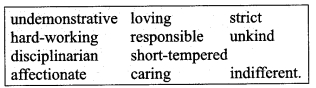
What kind of a person was he? You might find some of these words useful in describing him:
Answer:
No, Kezia’s father was not right to punish her. He should have understood that Kezia is a child and that it is okay for her to make mistakes. He could have explained her how important those papers were to him and that she should never do such a thing again.
He is a father who is undemonstrative, strict and short-tempered. He also has a loving and affectionate heart but he lets his disciplinarian behaviour get the better of him. He does unkind actions like beating her with a ruler but then he is also a caring dad who pacifies her when she wakes up from a bad dream.
Writing
Has your life been different from or similar to that of Kezia when you were a child? Has your perception about your parents changed now? Do you find any change in your parents’ behaviour vis-à-vis yours? Who has become more understanding? What steps would you like to take to build a relationship based on understanding? Write three or four paragraphs (150–200 words) discussing these issues from your own experience.
Answer:
For self-attempt.
 MRN Creator