I. Answer these questions in a few words or a couple of sentences each.
Question 1.
How old are Margie and Tommy?
Answer:
Margie is eleven and Tommy is thirteen years old.
Question 2.
What did Margie write in her diary?
Answer: Margie wrote in her diary “Today Tommy found a real book!”
Question 3.
Had Margie ever seen a book before?
Answer:
No, Margie had never seen a book before.
Question 4.
What things about the book did she find strange?
Answer:
The book had yellow and wrinkled pages.
The words of the book were still. They did not move as the words move on the computer screen. She found these things strange.
Question 5. What do you think a telebook is? Answer: I think the telebook must be a book that gets displayed on the screen of the television.
Question 6. Where was Margie’s school? Did she have any classmates? Answer: Margie’s school was next to her bedroom.
No, she did not have any classmates.
Question 7. What subjects did Margie and Tommy learn? Answer: Margie learnt Geography and Mathematics. Tommy learnt History and Mathematics.
II. Answer the following with reference to the story.
Question 1.
“I wouldn’t throw it away.”
- Who says these words?
- What does ‘it’ refer to?
- What is it being compared with by the speaker?
Answer:
- Tommy says these words.
- It refers to that real book that Tommy found.
- The speaker compares it with a telebook.
Question 2.
“ Sure, they had a teacher, but it wasn’t a regular teacher. It was a man.”
- Who does ‘they’ refer to?
- What does ‘regular’ mean here?
- What is it contrasted with?
Answer:
- ‘They’ refer to the people of the old times.
- Here, regular refers to the mechanical teacher then they had.
- It is contrasted with a normal teacher of earlier times, who was a living human being.
III. Answer each of these questions in a short paragraph (about 30 words).
Question 1.
What kind of teachers did Margie and Tommy have?
Answer: Margie and Tommy had mechanical teachers. They were taught on computers and television screens. They didn’t have a living person as a teacher who would teach the pupils in a classroom.
Question 2.
Why did Margie’s mother send for the County Inspector?
Answer:
Margie’s mother sent for the County Inspector because the mechanical teacher was not functioning efficiently. It had been giving her test after test in geography and she had been doing worse and worse.
Question 3.
What did he do?
Answer:
He slowed down the mechanical teacher’s speed upto an average ten-year level. The mechanical teacher’s speed was controlled and adjusted according to the IQ level of Margie.
Question 4.
Why was Margie doing badly in geography? What did the County Inspector do to help her?
Answer: Margie was doing badly in geography because the questions that were displayed on the screen of the mechanical teacher were too quick for her age.
The County Inspector slowed its speed to an average ten-year level so that Margie would be able to perform satisfactorily.
Question 5. What had once happened to Tommy’s teacher? Answer: Tommy’s teacher had to be taken away altogether for a month as the history sector had blanked out completely.
Question 6. Did Margie have regular days and hours for school? If so, why? Answer: Yes, Margie had regular days and hours for school because Margie’s mother believed that little girls learned better if they learned at regular hours.
Question 7. How does Tommy describe the old kind of school? Answer: Tommy says that the old kind of school had special buildings. All the kids went to that building for studying.
Question 8.
How does he describe the old kind of teachers?
Answer:
He says that the old teachers did not live in the house. They had a special building and all the kids went there. They gave homework to students. They were not mechanical teachers, but living human beings.
IV. Answer each of these questions in two or three paragraphs. (100-150 words).
Question 1.
What are the main features of the mechanical teachers and the schoolrooms that Margie and Tommy have in the story?
Answer:
Margie and Tommy have mechanical teachers. They need not go to school for getting a formal education. The mechanical teacher is placed in one of the rooms of the house and they can get the knowledge of various subjects of individually from the mechanical teacher. They don’t have such classrooms where students sit together. They study from the telebooks. So they don’t require books and exercise books. The examination system is very different. They do homework in a different way. Margie has to write them out in a punch code. She leamt it when she was six years old. So the system of their education is technologically advanced and not based on printed books.
Question 2.
Why did Margie hate school? Why did she think the old kind of school must have been fun?
Answer:
Margie hated her school because she had a mechanical teacher. It was in her house. She was supposed to sit in that room alone to complete her hometask or assignments. The part Margie hated most was the slot where she had to put homework and test papers. She thought that the old schools must have been fun because the students used to sit together in the classroom. They enjoyed, laughed and shouted in the schoolyard. Children needed company to enhance their skills. If they are isolated, they get depressed and dejected.
Question 3.
Do you agree with Margie that schools today are more fun than the school in the story? Give reasons for your answer.
Answer:
There is no doubt that today’s schools are more funny than the future school discussed in the story. This school has nothing but a mechanical teacher with no emotions and sentiments. It does not have the ability to understand the psychology of a child. Moreover, it guides a pupil according to its adjusted modes. But today’s schools work for the overall development of a child. They learn the same thing. The teaches are real human beings. They leam how to adapt themselves to the new surroundings and cope with the strangers. The students sit and leam together. These activities don’t give vent to the feelings of depression, alienation and segregation.
Thinking about language (Page 11)
I. Adverbs
Read this sentence taken from the story:
They had once taken Tommy’s teacher away for nearly a month because the history sector had blanked out completely. The word complete is an adjective. When you add -ly to it, it becomes an adverb.
Question 1.
Find the sentences in the lesson which match adverbs given in the box below.
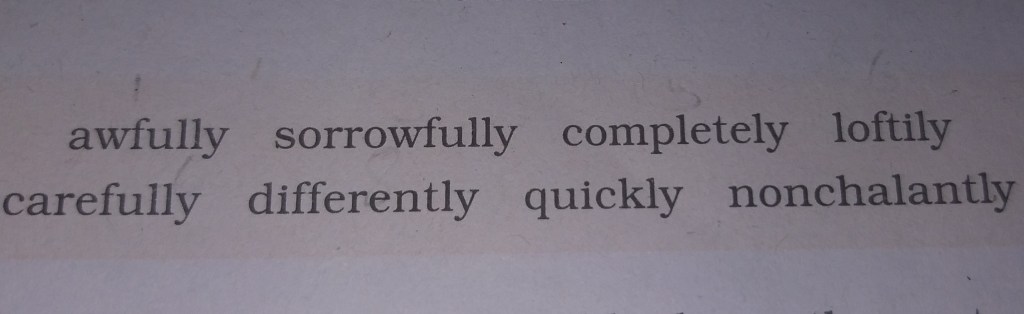
Answer:
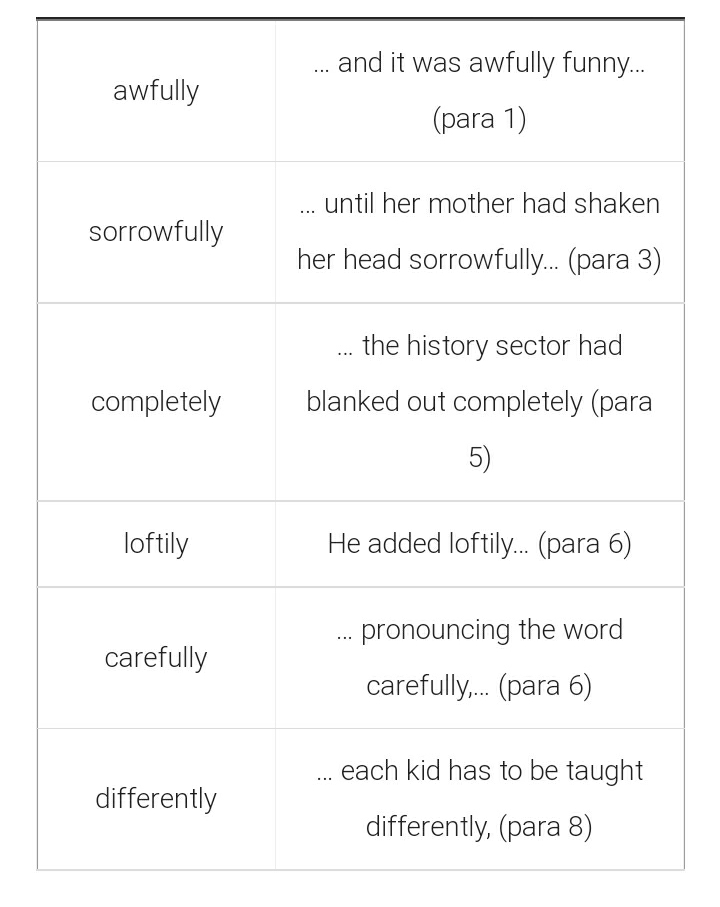
Question 2.
Now use these adverbs to fill in the blanks in the sentences below.
- The report must be read ……………….. so that performance can be improved.
- At the interview, Sameer answered our questions ……………….., shrugging his shoulders.
- We all behave ……………….. when we are tired or hungry.
- The teacher shook her head ……………….. when Ravi lied to her.
- I ……………….. forgot about it.
- When I complimented Revathi on her success, she just smiled ……………….. and turned away.
- The President of the Company is ……………….. busy and will not be able to meet you.
- I finished my work ……………….. so that I could go out to play.
Answer:
- carefully
- loftily
- differently
- sorrowfully
- completely
- nonchalantly
- awfully
- quickly
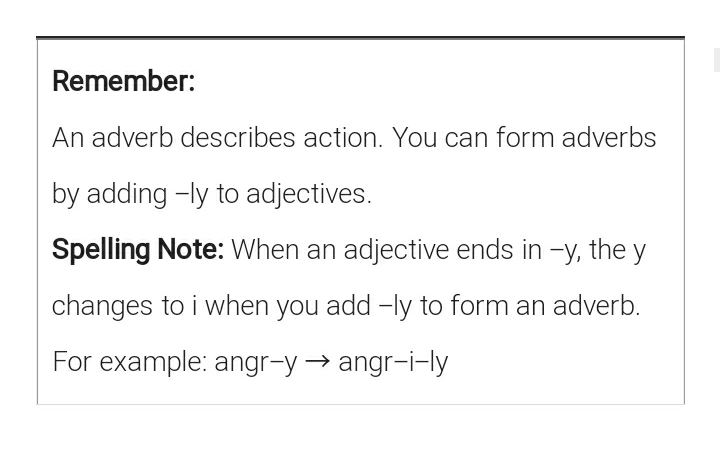
Question 3.
Make adverbs from these adjectives.
- angry …………….
- happy …………….
- merry …………….
- sleepy …………….
- easy …………….
- noisy …………….
- tidy …………….
- gloomy …………….
Answers:
- angry — angrily
- happy — happily
- merry — merrily
- sleepy — sleepily
- easy — easily
- noisy — noisily
- tidy — tidily
- gloomy — gloomily
II. If not and Unless
• Imagine that Margie’s mother told her, “You’ll feel awful if you don’t finish your history lesson.”
• She could also say: “You’ll feel awful unless you finish your history lesson.” Unless means if not. Sentences with unless or if not are negative conditional sentences.
Notice that these sentences have two parts. The part that begins with if not or unless tells us the condition. This part has a verb in the present tense (look at the verbs don’t finish, finish in the sentences above).
The other part of the sentence tells us about a possible result. It tells us what will happen (if something else doesn’t happen). The verb in this part of the sentence is in the future tense (you ’ll feelI you will feel).
Notice these two tenses again in the following examples:
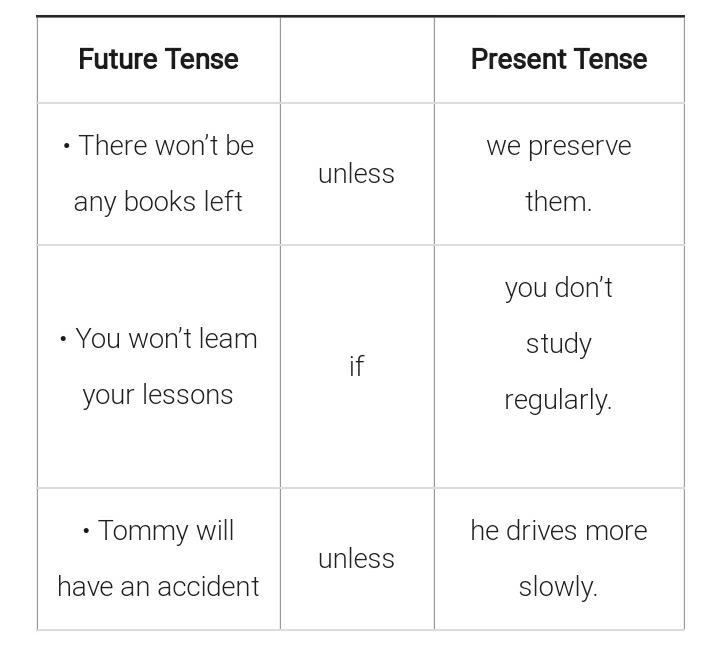
Question 1.
Complete the following conditional sentences. Use the correct form of the verb.
- If I don’t go to Anu’s party tonight,
……………………….. - If you don’t telephone the hotel to order food,
……………………….. - Unless you promise to write back, I
……………………….. - If she doesn’t play any games,
……………………….. - Unless that little bird flies away quickly, the cat
………………………..
Answers:
- If I don’t go to Anu’s party tonight, she will get annoyed.
- If you don’t telephone the hotel to order food, you will miss your evening meal.
- Unless you promise to write back, I shall keep requesting you.
- If she does not play any games, she will become lethargic and unfit.
- Unless that little bird flies away quickly, the cat will pounce on it.
Writing (Page 12)
A new revised volume of Isaac Asimov’s short stories has just been released. Order one set. Write a letter to the publisher, Mindfame Private Limited, 1632 Asaf Ali Road, New Delhi, requesting that a set be sent to you by Value Payable Post (VPP), and giving your address. Your letter will have the following parts.
- Addresses of the sender and receiver
- The salutation
- The body of the letter
- The closing phrases and signature Your letter might look like this:
Your address ……………………………………..
………………………………..
Date ………………. (DD/MM/YY)
The addressee’s address
………………………………..
………………………………..
Dear Sir/Madam,
………………………………..
………………………………..
Yours sincerely,
Your signature
Answer:
416, Sector 18
Nagpur, Maharashtra
04/08/2020
Mindfame Private Limited, 1632
Asaf Ali Road, New Delhi
Dear Sir/Madam,
I recently came to know that a new revised volume of Issac Asimov’s short stories has been released. This is to request you to send me a set of the same by Value Payable Post (VPP) on my mailing address. I shall be highly obliged.
Yours sincerely,
Adwait Tiwari
Remember that the language of a formal letter is different from the colloquial style of personal letters. For example, contracted forms such as ‘I’ve’ or ‘can’t’ are not used.
Speaking (Page 14)
In groups of four discuss the following topic.
‘The Schools of the Future Will Have No Books and No Teachers! ’
Your group can decide to speak for or against the motion. After this, each group will select a speaker to present its views to the entire class.
You may find the following phrases useful to present your argument in the debate.
- In my opinion . . .
- I/we fail to understand why . . .
- I wholeheartedly support/oppose the view that . . .
- At the outset let me say . . .
- I’d/we’d like to raise the issue of/argue against. . .
- I should like to draw attention to . . .
- My/our worthy opponent has submitted that . . .
- On the contrary . . .
- I firmly reject . . .
Answers:
For the motion
I would like to put forth my views in favour of the motion “The Schools of the Future Will Have No Books and No Teachers!”
The emergence of digital technologies like computers, laptops, mobile phones, etc. has brought about a lot of changes in the way education is imparted and received. Now itself, we can see how important the electronic gadgets and internet have become. We learn so many things through Google, YouTube and other platforms. The concept of online classes is getting more acknowledgement than ever. The internet speed is improving with time and usage. More and more people are being drawn towards the limitless possibilities of learning online. Gradually, we might see the schools teaching the students online with soft copies of books.
When the robots become a part of our lives, we shall see the time when the schools will have no real books and no human teachers, instead we will have online books and robots as teachers!
 MRN Creator