Thinking about the text
(Page 89)
I. Discuss in pairs and answer each question below in a short paragraph. (30-40 words)
Question 1.
How many characters are there in the narrative? Name them. (Don’t forget the dog!).
Answer:
There are four characters in the narrative including the dog. They are the narrator, George, Harris and the fourth is the dog named Montmorency.
Question 2.
Why did the narrator (Jerome) volunteer to do the packing?
Answer:
The narrator felt that he knew more about packing than any other person living. Moreover, he would get an opportunity to boss the job and George and Harris would do the job under his directions.
Question 3.
How did George and Harris react to this? Did Jerome like their reaction?
Answer: George and Harris reacted very differently from what the author had wanted them to. When Jerome said that he would do the packing, they readily accepted the suggestion. George spread himself over the easy-chair and Harris plonked his legs on the table.
No, Jerome was irritated at their reaction.
Question 4.
What was Jerome’s real intention when he offered to pack?
Answer:
Jerome’s real intention was to boss over the job and George and Harris to follow his orders.
Question 5.
What did Harris say after the bag was shut and strapped? Why do you think he waited till then to ask?
Answer:
Harris asked the narrator to put the boots in the bag after strapping the bag. He did it with an intention to irritate the narrator.
Question 6.
What ‘horrible idea’ occurred to Jerome a little later?
Answer:
Jerome was going to close the bag after putting the boots in it. He suddenly thought of his toothbrush. While travelling, he must needed the toothbrush which he packed in the bag. Now he had to search for it in the bag.
Question 7.
Where did Jerome finally find the toothbrush?
Answer:
Jerome unpacked everything and began to put the things back one by one. He held everything up and shook it. Then he finally found the toothbrush inside a boot.
Question 8.
Why did Jerome have to reopen the packed bag?
Answer:
Jerome packed his spectacles in the bag. So he had to reopen the packed bag.
Question 9.
What did George and Harris offer to pack and why?
Answer:
George and Harris offered to pack hamper because they wanted Jerome to take some rest. They decided to pack the rest of things themselves.
Question 10.
While packing the hamper, George and Harris do a number of foolish and funny things. Tick the statements that are true.
(i) They started with breaking a cup.
(ii) They also broke a plate.
(iii) They squashed a tomato.
(iv) They trod on the butter.
(v) They stepped on a banana.
(vi) They put things behind them, and couldn’t find them.
(vii) They stepped on things.
(viii)They packed the pictures at the bottom and put heavy things on top.
(ix) They upset almost everything.
(x) They were very good at packing.
Answer:
The true statements are as follows:
(i),(iii),(iv),(vi),(vii),(ix)
II. What does Jerome say was Montmorency’s ambition in life? What do you think of Montmorency and why? Answer:
Montmorency’s ambition in life is to interfere with others and be abused. He wants to be a perfect nuisance and make people mad. If things are thrown at his head, he feels his day has not been wasted. To get somebody to stumble over him, and curse him steadily for an hour is his highest aim and object. He came and sat on things, just when they were going to be packed. He put his leg into the jam and worried the teaspoons and pretended that lemons were rats and got into the hamper and killed three of them.
It is the natural, original sin that is bom in him that makes him do things like that.
III. Discuss in groups and answer the following questions in two or three paragraphs.
Question 1.
Of the three, Jerome, George and Harris, who do you think is the best or worst packer? Support your answer with details from the text.
Answer:
Of the three, Jerome is the best packer as he knows how to arrange things properly. He is not a flawless packer as he forgets things outside. Later, he searches for spectacles and finds out that he packed them too in the bag. Also, he has an odd habit of forgetting if he had packed his toothbrush.
George and Harris are equally worse in packing. They stepped on things. They put things behind them and then couldn’t find them when they wanted them. They packed the pies at the bottom, and put heavy things on top and smashed the pies in. They upset salt over everything and created a chaos in the room.
Question 2.
How did Montmorency ‘contribute’ to the packing?
Answer:
Montmorency’s contribution to the packing cannot be forgotten. His ambition in life was to disturb others and be abused by them. He came and sat on things, just when they were going to be packed and he put his leg into the jam. He disturbed everything. He pretended the lemons to be rats and got into the hamper and killed three of them.
Montmorency wanted to be a perfect nuisance and make people mad. If things are thrown at his head, he feels his day has not been wasted. To get somebody to stumble over him, and curse him steadily for an hour was his highest aim and objective. When he got succeeded in accomplishing it, his conceit became quite unbearable.
Question 3.
Do you find this story funny? What are the humorous elements in it? (Pick out at least three, think about what happens, as well as how it is described.)
Answer:
The story is really humorous and funny. Jerome’s episode of packing, Harris’s and George’s way of packing and Montmorency’s contribution have made the story funny and interesting. Jerome was confused about his toothbrush and found it in a boot. He also packed his spectacles in the bag. The incident of butter makes the reader laugh. George treads on the butter and it sticks to his slipper. Later he puts it on the chair. Harris sits on the chair and it sticks to his bottom. They squash the tomatoes by putting the strawberry jam on them.
Montmorency’s pretention for the lemons to be rats is also fascinating and funny.
These incidents are described in an orderly and perfect way.
Thinking about language
(Page 90)
Question 1.
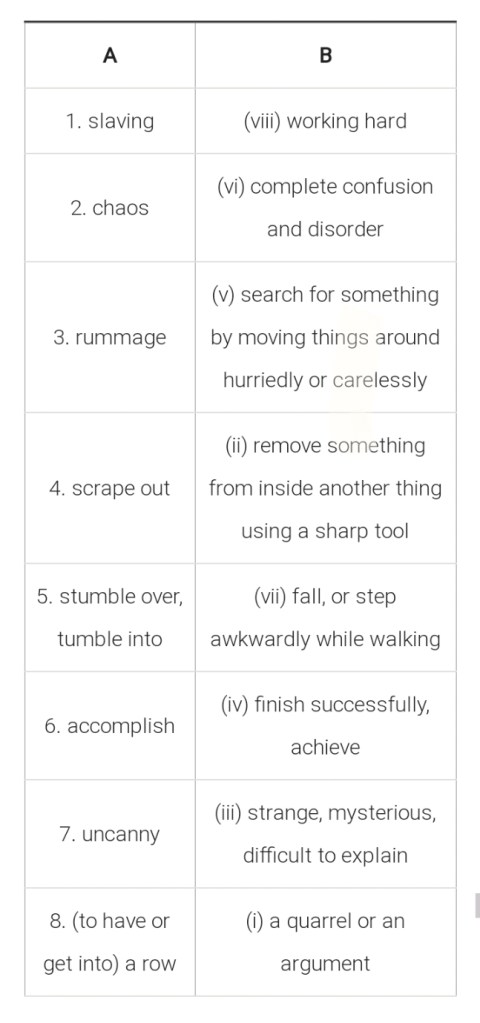
Match the words/phrases in Column ‘A’ with their meanings in Column ‘B’.
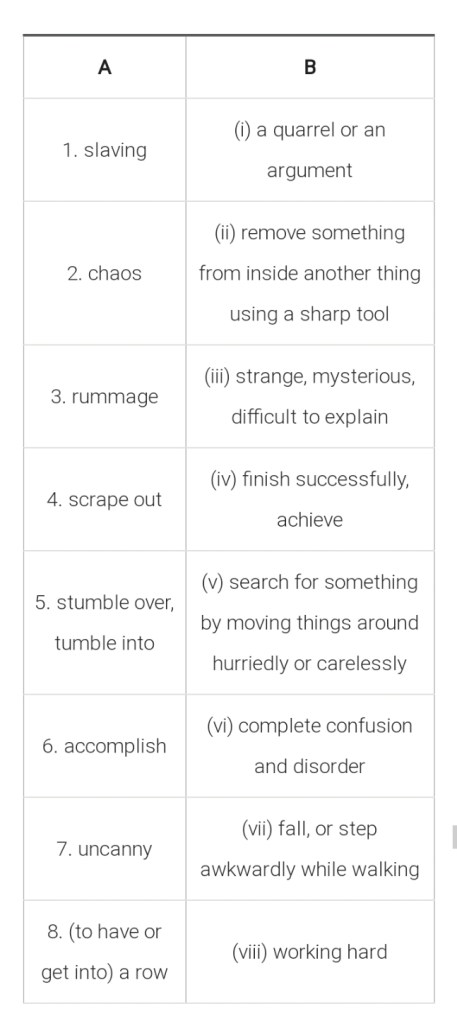
Answer:
Question 2.
Use suitable words or phrases from column A above to complete the paragraph given below.
A Traffic Jam
During power cuts, when traffic lights go off, there is utter ________ at crossroads. Drivers add to the confusion by ________ over their right of way, and nearly come to blows. Sometimes passers-by, seeing a few policemen ________ at regulating traffic, step in to help. This gives them a feeling of having ________ something.
Answers:
chaos, getting into a row, slaving, accomplished.
Question 3.
Look at the sentences below. Notice that the verbs (italicised) are all in their bare form.
- Simple commands:
- Stand up!
- Put it here!
- Directions: (to reach your home) Board Bus No. 121 and get down at Sagar Restaurant. From there turn right and walk till you reach a book shop. My home is just behind the shop.
- Dos and don’ts:
- Always get up for your elders.
- on’t shout in class.
- Instructions for making a fruit salad:
Ingredients:
Oranges – 2; Pineapple – one large piece; Cherries – 250 grams; Bananas – 2; Any other fruit you like
Wash the fruit. Cut them into small pieces. Mix them well. Add a few drops of lime juice. Add sugar to taste. Now add some cream (or ice cream if you wish to make fruit salad with ice cream.)
Question (i).
Now work in pairs. Give
- two commands to your partner.
- two do’s and don’ts to a new student in your class.
- directions to get to each other’s houses,
- instructions for moving the body in an exercise or a dance, or for cooking something.
Answers:
- Don’t waste time. Don’t spit here.
- Do’s : (a) Respect your teachers, (b) Behave properly.
Don’ts : (a) Don’t make a noise, (b) Don’t come late to the class. - Go straight on M.G. Road. Walk for 10 minutes. Look to the left. There is a park nearby. Across the park, there is my house. It looks like a bungalow with a Holy Cross structure.
- Instructions: Sit cross-legged. Raise your palm. Put the thumb on one nostril. Breathe into the air. Then close the open nostril with the tip of the first finger. Remove the thumb from the first nostril. Breathe out the air through the first nostril. This is the yoga called ‘Lorn VHom’
Question (ii).
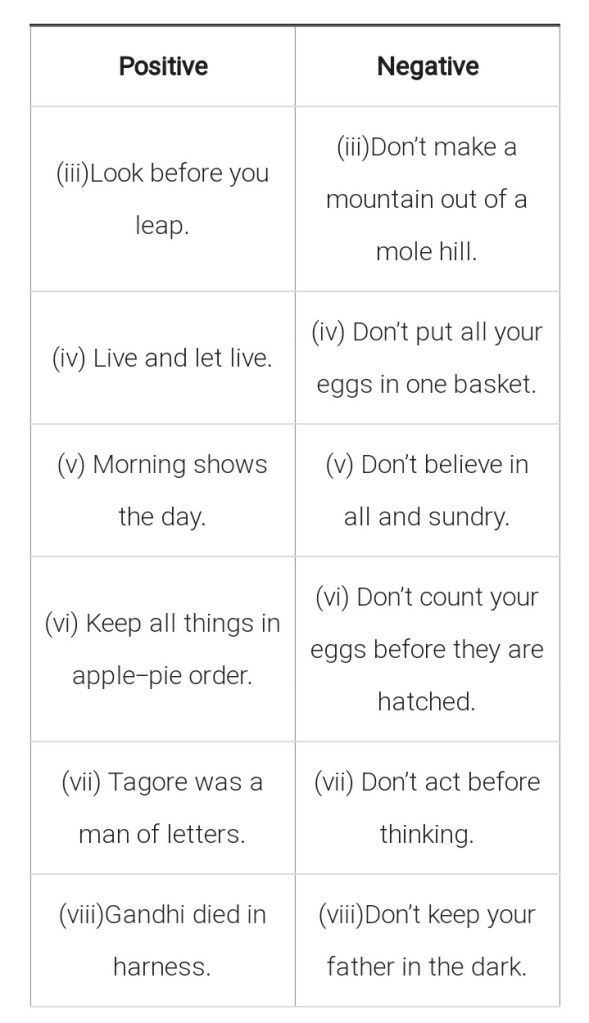
The table below has some proverbs telling you what to do and what not to do. Fill in the blanks and add a few more such proverbs to the table.
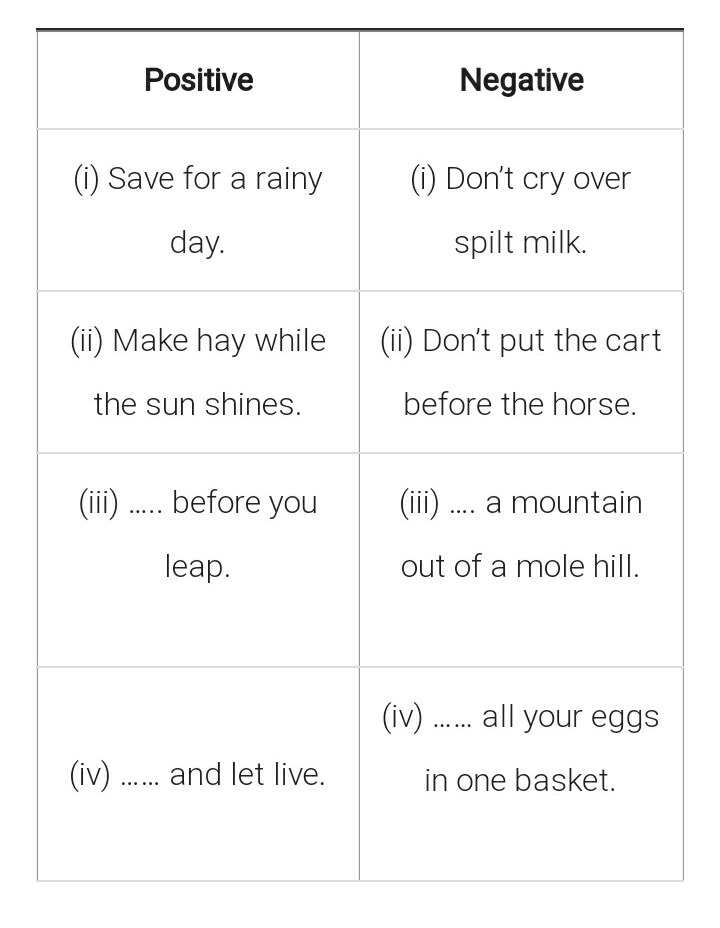
Answer:
Writing
(Page 92)
You have seen how Jerome, George and Harris mess up their packing, especially of the hamper. From their mistakes you must have thought of some do’s and don’ts for packing. Can you give some tips for packing by completing the paragraph below?
First pack all the heavy items, especially the ones you don’t need right away. Then Here are some words and phrases you can use to begin your sentences with:
- Then
- Next
- Now
- Remember
- Don’t forget
- At last/Finally
Answers:
Do it yourself.
Speaking
(Page 92)
Look at this sentence.
“I told George and Harris that they had better leave the whole matter entirely to me.”
The words had better are used
- in an advice or suggestion:
You had better take your umbrella; it looks like rain. - in an order
You had better complete your homework before you go out to play. - as a threat
You had better leave or I’ll have you arrested for trespass !
When we speak, we say you ’d/I’d/he’d better, instead of you had better, etc.
Question 1.
Work in pairs to give each other advice, orders or suggestions, or even to threaten each other. Imagine situations like the following: Your partner
- Hasn’t returned a book to the library.
- Has forgotten to bring lunch.
- hasn’t got enough change for bus fare.
- has found out a secret about you.
- has misplaced your English textbook.
Answers:
1. You had better return the book to the library.
2. You had better bring lunch.
3. You had better get enough change for bus fare.
4. You had better tell me the secret you found out about me.
5. You had better not misplace your English textbook.
Activity
(Page 93)
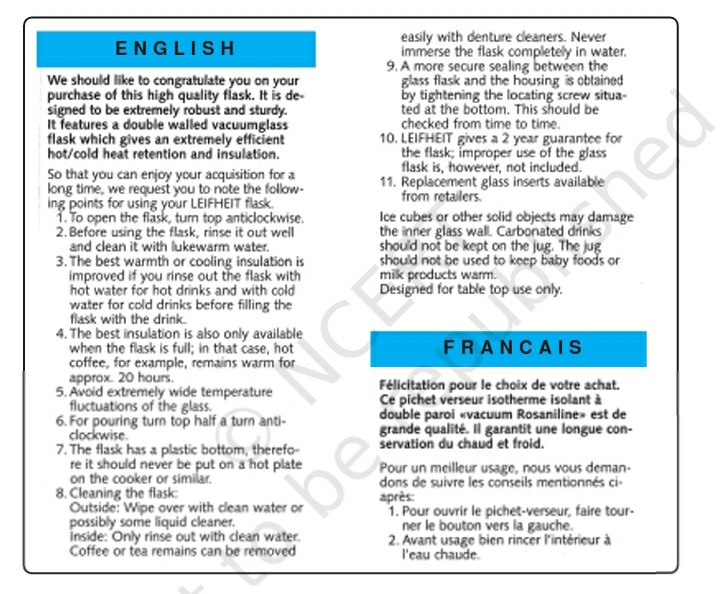
• Collect some examples of instructions, directions, etc. from notice boards and pamphlets. Bring them to class and display them, or read them out. (You can collect examples in English as well as other languages, Indian or foreign.) Here is an example for you:
 MRN Creator