Thinking about the Text
(Page 60)
I. Discuss in pairs and answer each question below in a short paragraph
Question 1.
“ The sound was a familiar one.” What sound did the doctor hear? What did he think it was? How many times did he hear it? (Find the places in the text.) When and why did the sounds stop?
Answer:
The doctor heard the sound of rats. The sound was a familiar one. He heard this sound four times. The phrases are ‘Again I heard that sound from above’, ‘Again came that noise from above’, ‘Suddenly there came a dull thud as if a rubber tube has fallen’. The sounds stopped after the appearance of the snake.
Question 2.
What two “important” and “earth¬shaking” decisions did the doctor take while he was looking into the mirror?
Answer:
The doctor took the following two ‘important’ and ‘earth shaking’ decisions:
(a) He would shave daily and grow a thin moustache to look more handsome.
(b) He would always keep that attractive smile on his face.
Question 3. “I looked into the mirror and smiled,” says the doctor. A little later he says, “I forgot my danger and smiled feebly at myself.”
What is the doctor’s opinion about himself when: (i) he first smiles, and (ii) he smiles again? In what way do his thoughts change in between, and why?
Answer:
(i) When the doctor smiled first, he was thinking that his smile was very attractive.
(ii) When he smiled again, he was thinking that he was a poor and stupid doctor.
His thoughts changed from being a handsome doctor to being a stupid doctor between the two situations. His thoughts changed because his life was now in danger.
II. This story about a frightening incident is narrated in a humorous way. What makes it humorous? (Think of the contrasts it presents between dreams and reality. Some of them are listed below.)
Question 1. (i) The kind of person the doctor is (money, possessions)
(ii) The kind of person he wants to be (appearance, ambition)
Answer:
(i) The doctor is a person whose earnings were meagre. His house was a small rented room. He only had 60 rupees, some shirts, dhotis and a black coat.
(ii) He believes in making himself look handsome. He decides that he would shave daily and grow a thin moustache.
Question 2. (i) The person he wants to marry
(ii) The person he actually marries
Answer:
(i) He wants to marry a fat woman doctor who had plenty of money.
(ii) He marries to a thin reedy person with the gift of a sprinter.
Question 3. (i) His thoughts when he looks into the mirror
(ii) His thoughts when the snake is coiled around his arm
Write short paragraphs on each of these to get your answer.
Answer:
(i) He thinks that he should look smart. So he decides to shave daily and retain his smile. He is happy and contented when he looks into the mirror.
(ii) When the snake coiled around his left arm above the elbow, he kept sitting there holding his breath. He became motionless. He was afraid of the snake.
Thinking about language
(Page 61)
Question 1.
Here are some sentences from the text. Say which of them tell you, that the author:
(a) was afraid of the snake, (b) was proud of his appearance, (c) had a sense of humour, (d) was no longer afraid of the snake.
- I was turned to stone.
- I was no mere image cut in granite.
- The arm was beginning to be drained of strength.
- I tried in my imagination to write in bright letters outside my little heart the words, ‘O God’.
- I didn’t tremble. I didn’t cry out.
- I looked into the mirror and smiled. It was an attractive smile.
- I was suddenly a man of flesh and blood.
- I was after all a bachelor, and a doctor too on top of it!
- The fellow had such a sense of cleanliness … ! The rascal could have taken it and used it after washing it with soap and water.
- Was it trying to make an important decision about growing a moustache or using eye shadow and mascara or wearing a vermilion spot on its forehead.
Answers:
- The sentences (1), (3), (4), (5) tell that the author (a) was afraid of the snake.
- The sentences (6) and (8) tell that he
(b) was proud of his appearance. - The sentences (9) and (10) tell that
(c) he had a sense of humour. - The sentences (2) and (7) tell that (d) he was no longer afraid of the snake.
Question 2.
Expressions used to show fear
Can you find the expressions in the story that tell you that the author was frightened? Read the story and complete the following sentences.
- I was turned ……………….
- I sat there holding ……………….
- In the light of the lamp I sat there like ……………….
Answers:
- I was turned to stone.
- I sat there holding my breath.
- In the light of the lamp I sat there like a stone image in the flesh.
Question 3.
In the sentences given below some words and expressions are italicised. They variously mean that one
- is very frightened.
- is too scared to move.
- is frightened by something that happens suddenly.
- makes another feel frightened.
Match the meanings with the words/ expressions in italics, and write the appropriate meaning next to the sentence. The first one has been done for you.
- I knew a man was following me, I was scared out of my wits,
- I got a fright when I realised how close I was to the cliff edge.
- He nearly jumped out of his skin when he saw the bull coming towards him.
- You really gave me a fright when you crept up behind me like that.
- Wait until I tell his story—it will make your hair stand on end.
- Paralysed with fear, the boy faced his abductors.
- The boy hid behind the door, not moving a muscle.
Answers:
- I knew a man was following me, I was scared out of my wits, (very frightened)
- I got a fright when I realized how close I was to the cliff edge, (too scared to move).
- He nearly jumped out of his skin when he saw the bull coming towards him. (frightened by something that happens suddenly)
- You really gave me a fright when you crept up behind me like that, (made someone feel frightened)
- Wait until I tell his story—it will make your hair stand on end. (very frightened)
- Paralysed with fear, the boy faced his abductors, (too scared to move)
- The boy hid behind the door, not moving a muscle, (too scared to move)
Question 4.
Report these questions, using if/whether or why/when/where/how/which/what. Remember the italicised verbs change into the past tense.
- Meena asked her friend, “Do you think your teacher will come today?”
- David asked his colleague, “Where will you go this summer?”
- He asked the little boy, “Why are you studying English?”
- She asked me, “When are we going to leave?”
- Pran asked me, “Have you finished reading the newspaper?”
- Seema asked her, “How long have you lived here?”
- Sheila asked the children, “Are you ready to do the work?”
Answers:
- Meena asked her friend if he (she) thought his (her) teacher would come that day.
- David asked his colleague where he would go that summer.
- He asked the little boy why he was studying English.
- She asked me when they were going to leave.
- Pran asked me if I had finished reading the newspaper.
- Seema asked her how long she had lived there.
- Sheila asked the children if they were ready to do the work.
Speaking
(Page 63)
Question 1.
Using some of the expressions given above in exercise III, talk about an incident when you were very scared. You may have a competition to decide whose story was the most frightening.
Answer: For self-attempt.
Dictation
(Page 63)
The following paragraph is about the Indian Cobra. Read it twice and close your book. Your teacher will then dictate the paragraph to you. Write it down with appropriate punctuation marks.
The Indian cobra is the common name for members of the family of venomous snakes, known for their intimidating looks and deadly bite. Cobras are recognized by the heads that they flare when angry or disturbed; the heads are created by the extension of the ribs behind the cobras’ heads. Obviously the best prevention is to avoid getting bitten. This is facilitated by the fact that humans are not the natural prey of any venomous snake. We are a bit large for them to swallow whole and they have no means of chopping us up into bite-size pieces. Nearly all snakebites in humans are the result of a snake defending itself when it feels threatened. In general snakes are shy and will simply leave if you give them a chance.
Answer:
Do it yourself.
Writing
(Page 63)
Question 1.
Try to rewrite the story without its humour, merely as a frightening incident. What details or parts of the story would you leave out?
Answer:
Do yourself.
Question 2.
Read the description given alongside this sketch from a photograph in a newspaper (Times of India, 4 September 1999). Make up a story about what the monkey is thinking, or why it is looking into a mirror. Write a paragraph about it.
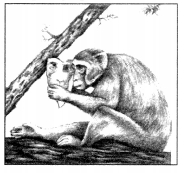
The fairest of them all
A monkey preens itself using a piece of mirror, in the Delhi ridge.
(‘To preen oneself ’ means to spend a lot of time making oneself look attractive, and then admiring one’s appearance. The word is used in disapproval.)
Answer:
THE FAIREST OF THEM ALL
On a bright day, a monkey was having fun climbing and jumping across trees. Suddenly he saw a shining piece of mirror on the ground. He jumped down and had a close look at the mirror. At first, he could not understand what it was. After some time, he realised that the thing in his hand showed him his reflection. He looked at his face in the mirror. He removed twigs and dust that were stuck on his face. He made several faces and kept looking at his reflection. He touched his head and rubbed his hair. He preened himself for long. Then he threw the mirror back on the ground and took a leap onto the next tree.
Translation
(Page 64)
The text you read is a translation of a story by a well-known Malayalam writer, Vaikom Muhammad Basheer.
In translating a story from one language to another, a translator must keep the content intact. However, the language and the style differ in different translations of the same text.
– Here are two translations of the opening paragraphs of a novel by the Japanese writer, Haruki Murakami. Read them and answer the questions given below :
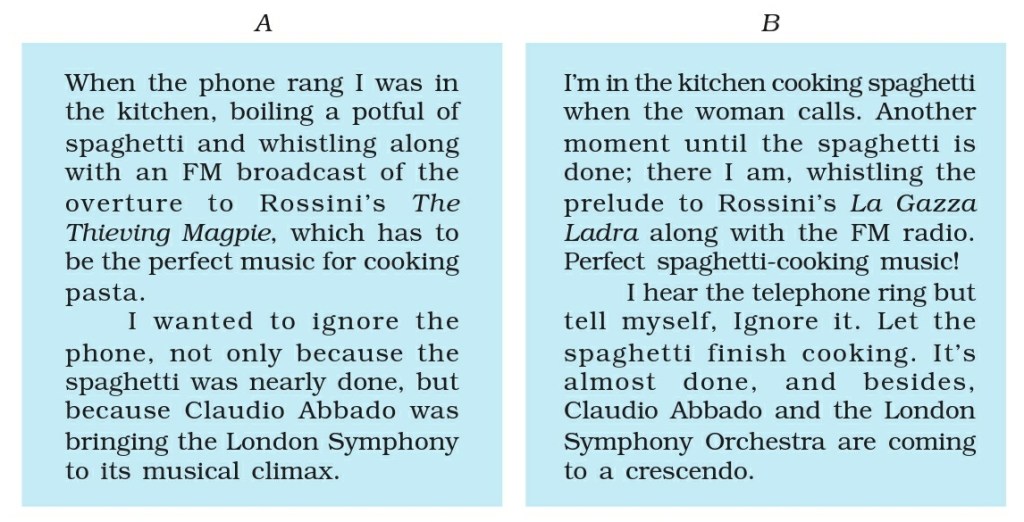
Compare the two translations on the basis of the following points :
- the tense of narration (past and present tense)
- short, incomplete sentences
- sentence length
Which of these translations do you like? Give reasons for your choice.
Answer:
- The tense of narration (past and present tense)
Opinion: In Column A, sentences are written in the past tense whereas in Column B, they are written in the future tense.
- Short, incomplete sentences Opinion: In Column B short sentences are used. They are framed in the present tense.
- Sentence length
Opinion : The Column B has short sentences. They are simple and easily comprehensible. Besides, they are framed in the present tense.
Reason : I like the paragraph marked as B. The sentences are framed in the present tense. They give out clear-cut ideas in its simple form. We can easily remember the facts expressed in the present tense.
 MRN Creator